Melkinlaituri primary school and day care centre – pilot project for the reuse of hollow-core slabs
Approximately 350 square metres of reused hollow-core slabs have been installed in the ground floor structure of the Melkinlaituri primary school and day care centre. Sustera served as the project’s circular economy consultant.

Contents
Ambitious criteria for material efficiency
YIT is delivering the Melkinlaituri school and day care centre for the City of Helsinki as a life-cycle project. Sustera supported the definition and development of the project’s life-cycle objectives during the tender phase in close collaboration with YIT and the design team.
“We were responsible for assessing, implementing and steering the project’s material efficiency performance, among other aspects. The targets were aligned with the criteria of the RTYL environmental certification. Meeting these targets required the integration of recycled solutions, renewable materials and the systematic reuse of structural components,” says Juhani Huuhtanen, Senior Consultant and Team Leader at Sustera.
Reused hollow-core slabs in the ground floor structure
A section of the ground floor structure at the Melkinlaituri primary school and day care centrewas delivered using reused precast hollow-core slabs. These cover approximately 350 square metres of the ground floor area. The slabs were carefully dismantled from a multi-purpose building completed in 1981 in Suutarila, Helsinki.
The Melkinlaituri school and day care centre serves as a pilot project for the reuse of hollow-core slabs. It is the first commercial project in Finland to utilise them.
“Hollow-core slabs proved to be a technically viable and cost-effective solution for the scheme. As standardised, modular elements, they are relatively straightforward to reuse. In most buildings, hollow-core slabs account for a significant proportion of the precast concrete elements. They also have a material impact on the embodied emissions of the structural frame,” says Huuhtanen.
During the tender phase, the steering of material efficiency targets and carbon footprint quality criteria therefore progressed in parallel. Circular economy solutions often also contribute to lower embodied carbon.
“A reused building component has an embodied carbon footprint that is, in practical terms, close to zero.”

On the left are reused hollow-core slabs, and on the right are completely new ones. The difference is not visible to the eye.
Recycled glass wool in internal partitions
In the Melkinlaituri school and day care centre project, material efficiency was assessed at the level of individual building elements. Specific requirements were set for the proportion of recycled, reused or renewable content within each component.
In addition to the reuse of hollow-core slabs, the project team also explored options such as the reuse of bricks. In school developments, brick façades are often preferred for external walls. Ultimately, however, the recycled content requirement for the external wall assemblies was most effectively met by incorporating recycled glass wool insulation as the thermal insulation layer.
Recycled glass wool was also specified for the stud drywall walls. “This enabled the project to meet the material efficiency quality requirements for both the external wall assemblies and the internal partitions”, says Sustera’s specialist Juuso Ojala.
The suspended ceilings also contributed to achieving quality credit. The acoustic ceiling tiles contain approximately 50 per cent recycled mineral wool content.
Towards cost efficiency
The reuse of construction materials can increase labour costs, particularly where careful dismantling and quality control are required. On the other hand, disposal of demolition waste also carries a cost, and recovered materials may retain residual market value.
Through Sustera’s resource inventory service, clients receive a quantified financial assessment of the components that can potentially be reused or resold from a given property.
“From a contractor’s perspective, directing reusable components back into circulation is a commercially sound approach. The resource inventory report assigns a monetary value to the potential reuse of items such as windows, doors, glazed partitions and precast concrete elements,” says Ojala.
“In an optimal scenario, demolition and logistics processes would be organised efficiently enough to make reuse commercially competitive. That is clearly the direction in which the market is developing”, Huuhtanen adds.

Pictures: YIT
Sustera also delivered energy modelling and life-cycle planning for the project. Following the tender phase, Sustera has continued to steer the detailed design and delivery stages of the scheme: reviewing and commenting on procurement decisions, assessing the impact of design changes, and ensuring that the agreed performance targets are achieved.
Read also
Praise for the Geolo Team in Raisio, Finland: “The Collaboration Was Exactly What You Would Hope for from a Service Like This”
Sustera’s ground source heat pump solution, Geolo, improved conditions at the Tiedonpuisto School construction site and reduced its emissions. Geolo provided cooling during the summer as well as greater certainty regarding the schedule and material drying.
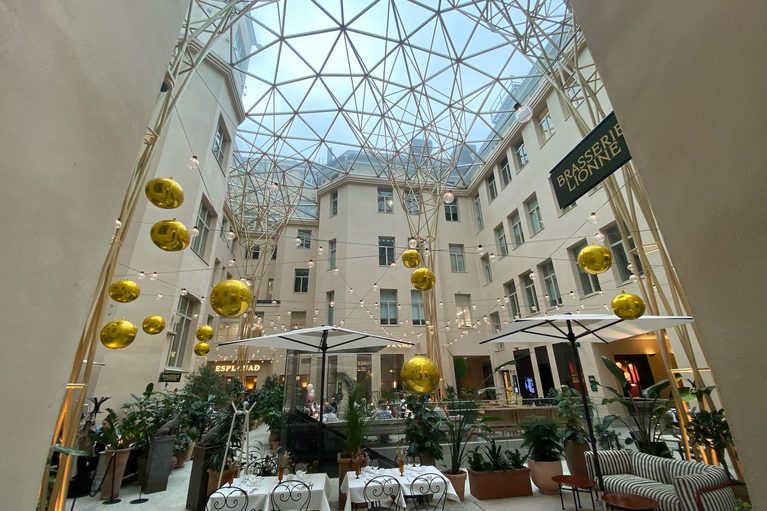
Structural Engineering for an Award-Winning Heritage Property: Covering the Courtyard and Developing Commercial Premises at Pohjoisesplanadi 37
The courtyard covering and development of new commercial premises at Pohjoisesplanadi 37 in the heart of Helsinki has received several industry accolades, including the Rakentamisen Ruusu (Rose of Construction) Award 2026 and Steel Structure of the Year award 2025. Sustera was responsible for the project's structural engineering design.
Aktiivitilat: Sustera’s technical management enabled greater focus on client work
Smooth day‑to‑day operations through technical management As the technical manager, Sustera is…